Printable guide
Cenote Chaak Tun: Complete Visitor Guide Near Playa del Carmen
Updated
Cenote Chaak Tun is a guided underground cenote experience close to Playa del Carmen, with two cavern environments, clear freshwater, limestone formations, and a practical half-day format. Learn how to visit, what the tour involves, who it suits, and how to plan the day.

Cenote Chaak Tun is one of the most convenient ways to experience the underground side of the Riviera Maya from Playa del Carmen. Instead of driving deep into the jungle or planning a full-day cenote circuit, you can reach this guided cavern attraction from the city and spend a few hours swimming, snorkeling, and looking at limestone formations beneath the ground. The visit is structured, equipment-led, and more atmospheric than a simple open-air swim.
The important distinction is that Chaak Tun is not a free-form swimming hole. Visitors generally explore the underground cenotes with a local guide, wearing required safety equipment and following the route through the caves. That makes the experience easier for first-time visitors, but it also means you should not arrive expecting to wander wherever you like or bring every piece of personal gear. The operator’s current rules, health requirements, photography policy, and schedule take priority on the day.
If you enjoy cool freshwater, enclosed spaces, short swims, and natural rock formations, Chaak Tun can be a strong half-day choice from Playa del Carmen. If your ideal cenote is a sunny pool with a gradual shallow edge, loungers, and no fixed group route, choose an open cenote instead. Chaak Tun rewards curiosity and a willingness to follow instructions more than it rewards spontaneous beach-style relaxation.
Underground water and limestone formations at Cenote Chaak Tun near Playa del Carmen
Quick answer: is Cenote Chaak Tun worth visiting?
Yes, for travelers who want a guided cave-and-water experience close to Playa del Carmen. Chaak Tun is worth considering when you want to see stalactites and stalagmites, swim in freshwater away from the midday heat, and learn how cenotes fit into Maya history and the peninsula’s underground water system. Its location makes it easier to add to a Playa del Carmen itinerary than many inland cenotes.
It is a particularly good fit for couples, friends, first-time cenote visitors who prefer a guide, families whose children meet the current requirements, and travelers who would rather have transport and equipment coordinated. It is less suitable if you are uncomfortable in dark or confined spaces, need completely independent access, want to dive without a specialist operation, or need very shallow water for toddlers.
The answer also depends on where you are staying. From central Playa del Carmen, Chaak Tun is a practical outing. From Tulum or Cancún, it may still be available as part of a wider excursion, but a closer cenote or destination-specific tour may make more sense. Check the actual pickup route and total time rather than judging the attraction only by its map distance.
What is Cenote Chaak Tun?
A cenote is an opening into the groundwater and cave system beneath the limestone of the Yucatán Peninsula. Rain filters through porous rock, moves through underground channels, and collects in chambers. When a roof collapses or an opening is accessible, people can reach that water from the surface. Some cenotes are open pools under the sky. Others are semi-open chambers with shafts of light. Chaak Tun is known for its underground, cavern-oriented setting.
The name is commonly explained through Maya language: Chaak refers to the rain deity and tun to stone. You will see the name written as Chaak Tun and sometimes Chaak-Tun in travel material. The attraction has also been associated with the former name Las Brujas in older descriptions. When asking for directions, use the current map pin and official name shown by the operator rather than relying on an old blog address.
The visitor experience is built around more than one cavern environment. Current tour descriptions describe two underground cenotes, with water, rock formations, and passages that make the visit feel like a small cave expedition. Details of the route can vary with weather, maintenance, water conditions, group size, and the selected package, so do not assume a description from a past year guarantees the exact same sequence.
The formations are the reason to look up and slow down. Stalactites hang from cave ceilings; stalagmites rise from the floor. Some are slender, some broad, and some appear where mineral-rich water has built layers over long periods. They are fragile. Touching them, standing on them, or bumping them with fins or equipment damages a formation that cannot be replaced on a human timescale.
The caves also have their own sound. A group’s voices can echo, water can move against the rock, and bats or other cave wildlife may be present. That atmosphere is part of the appeal, but it is also why guides matter. Keep your voice low when asked, leave wildlife alone, and avoid treating the cavern like a photo studio.
What the visit is actually like
A Chaak Tun visit generally begins at reception or the meeting area, where staff confirms the booking or entry, explains the route, and provides equipment required for the selected experience. Depending on the current operation, this may include a life jacket, helmet, water shoes, wetsuit, snorkel equipment, and a light. The exact inclusions vary, so check the booking details rather than assuming every item is included in every ticket.
You may walk along a jungle path or platform before reaching the first water area. The transition from the hot, bright Riviera Maya to a cool cave is immediate. The path may include uneven ground, steps, or surfaces that are slippery when wet. Wear something you can move in and listen carefully when the guide explains where to place your feet.
The first cavern establishes the character of the visit: freshwater, low light, rock above and below, and a route easier to understand when you stay close to the group. You may swim or wade depending on the section and water level. Even strong swimmers should use required flotation equipment. A life jacket is not a judgment about your ability; it helps keep the group visible and reduces fatigue in cool water.
A second cavern or section adds contrast. Operator descriptions mention formations, light from lamps, and cultural interpretation related to the Maya concept of Xibalba, often translated as the underworld. You may see an altar or other cultural feature described by the guide. Listen to the explanation rather than trying to handle or climb around anything. A cenote is both a natural environment and a place with cultural significance.
The water can look brighter in photographs than it feels in person. Underground water absorbs the available light, and the best view may come from the guide’s lamp or a shaft of daylight rather than a phone camera. Do not spend the entire tour trying to create images. In many cave attractions, personal photography is limited or controlled for safety and preservation, and official photo packages may be offered. Confirm the current rule when you arrive.
Allow more time than the advertised in-water duration. Transport, check-in, changing, safety instructions, the walk to the cave, and waiting for the group all add to the outing. A tour provider may describe the activity as roughly two or three hours while hotel pickup makes the door-to-door experience longer. Build a buffer before a dinner reservation, ferry, airport transfer, or timed evening activity.
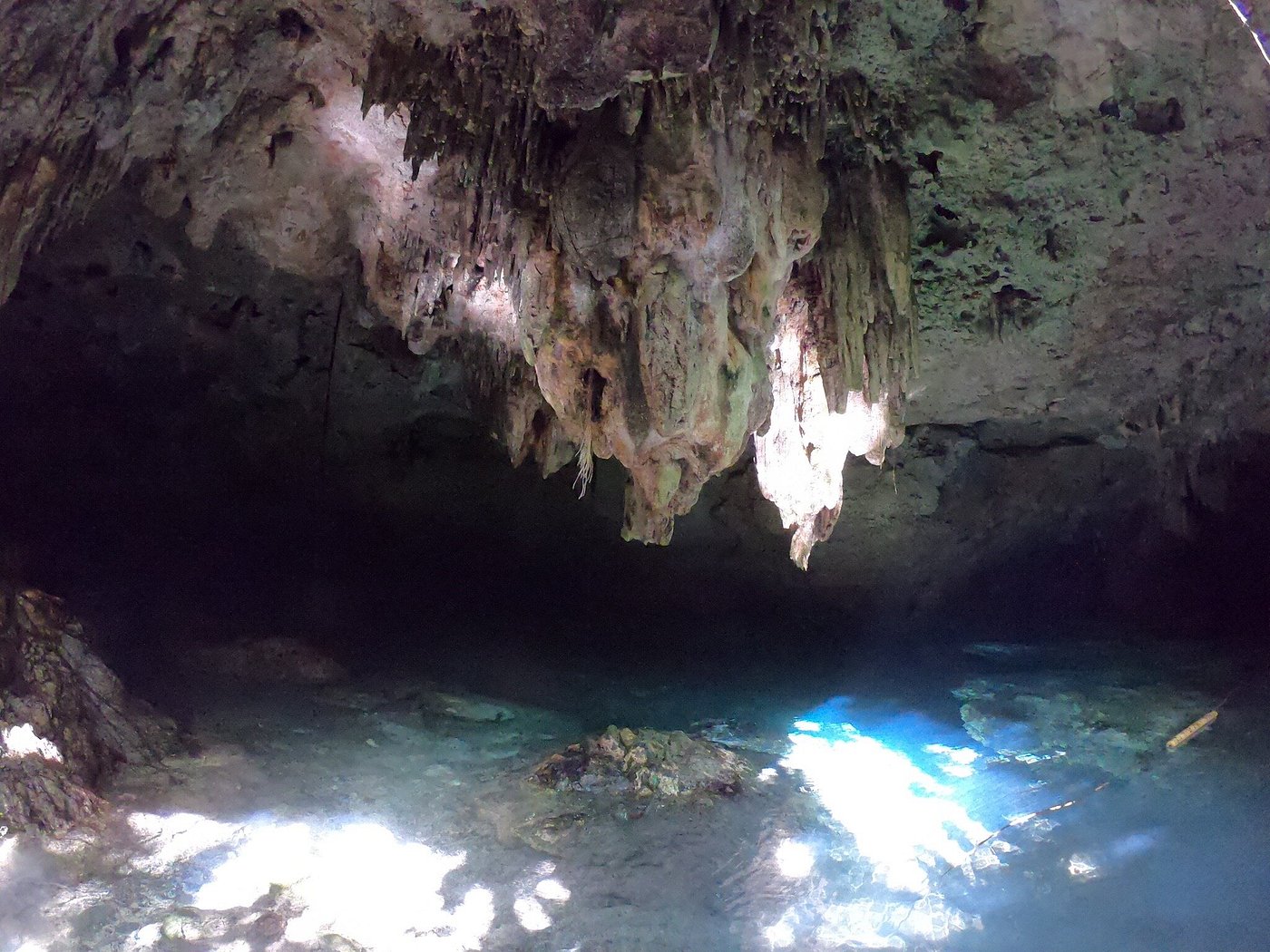 A second view of underground water and cave formations at Cenote Chaak Tun, Playa del Carmen
The cave environment and the Maya connection
Cenotes are not simply attractive swimming pools. For Maya communities, water in a landscape without surface rivers was essential, and cenotes could be sources of freshwater as well as places with spiritual meaning. The concept of Xibalba is often presented as an underworld connected to caves and water. The details of Maya belief are complex, and a short tourist explanation cannot replace archaeological or community-led scholarship, but the central point is useful: these places have meaning beyond their appearance on a travel itinerary.
That context should shape your behavior. Enter the water only where the operator directs you. Do not apply sunscreen immediately before swimming, even if the product is marketed as reef-safe; follow the site’s shower and environmental rules. Keep food, drinks, and litter away from the water. Do not bring loose jewelry or objects that could fall into a crack. Avoid loud music and do not touch formations, fish, roots, ceremonial features, or cave walls.
Underground water is also part of a connected aquifer. What enters one cenote can move through the wider system. This is why showering before entering and limiting products on your skin are practical conservation measures rather than arbitrary rules. Some operators ask guests to apply biodegradable sunscreen or repellent well before the activity and then shower. Others prohibit sunscreen during the visit. The current instructions at Chaak Tun are the ones to follow.
How to get to Cenote Chaak Tun from Playa del Carmen
Chaak Tun is outside the busiest beachfront and Fifth Avenue area of Playa del Carmen, but it is close enough to work as a short city-based excursion. The most practical choice depends on your group, your tolerance for arranging local transport, and whether you are already booking a guided visit.
Taxi or private transfer
A taxi is the simplest independent option from central Playa del Carmen. Before leaving, agree on the destination and understand how you will arrange the return. Ask the driver whether they can return at a stated time, or arrange a return through reception if that service is available. Do not assume a taxi will be waiting at exactly the moment you finish.
A private transfer is useful for families, travelers carrying several bags, or groups that want a confirmed vehicle. It costs more than a shared van but reduces uncertainty. Ask whether the quoted service includes waiting time and whether the driver will remain nearby or return later.
Rental car
Driving gives you control over the start time and makes it easier to combine Chaak Tun with another Playa del Carmen-area stop. Use the current official map pin, leave extra time for unfamiliar turns, and do not rely on a weak mobile signal. Download the route before leaving. Keep valuables out of sight and follow the site’s current parking instructions.
A car is not automatically the best choice. If you plan to drink, if nobody wants to navigate, or if you are unfamiliar with Mexican roads, a guided transfer can be less stressful. If you rent, inspect the vehicle, understand the insurance you have accepted, and avoid rushing back on wet roads after a swim.
Colectivo or local public transport
Shared vans can be inexpensive, but Chaak Tun is not as straightforward as a destination directly on Highway 307. Routes and drop-off arrangements change, and a driver may not stop at a private entrance unless you clearly explain where you are going. Ask locally at the current colectivo stand and confirm the walking portion before choosing this option.
Do not treat an old fare, route, or landmark as permanent. Carry small pesos, keep your phone charged, and save the location offline. If the final walk is along a road without a comfortable pedestrian shoulder, switch to a taxi rather than forcing a difficult route in the heat.
Organized tour with pickup
A guided tour is the most predictable choice for visitors who want transportation and equipment included. Current marketplace listings show Chaak Tun-specific and Playa del Carmen cenote inventory, but availability, pickup zones, health requirements, and inclusions differ by date. Compare the actual meeting point, cancellation terms, and total duration.
Compare Playa del Carmen cenote tours on GetYourGuide · See the Cenote Chaak Tun tour on Viator
A tour is sensible if Chaak Tun is your first cave swim, if you are traveling without a car, or if you want the guide to explain formations and cultural background. It is less attractive if you only want a quick independent look and are comfortable organizing your own return.
Tickets, hours, and what to confirm
Published details for Chaak Tun vary significantly between websites and tour operators. Some descriptions show a morning-to-afternoon visitor window, while others list different closing times or last-entry arrangements. Prices also vary by whether you buy a basic entrance, a guided local experience, hotel pickup, equipment, or an additional cultural activity. Treat old peso and dollar figures as historical references, not as a promise.
Before traveling, confirm the current opening days and first and last entry; whether you need a reservation; the current price and accepted payment; what equipment is included; the meeting point; pickup zones; age, swimming, and health requirements; the photography policy; and whether weather, maintenance, or water conditions can change the route.
If you are booking through a marketplace, read the “included” and “not included” sections all the way through. A listing may call an activity a three-hour tour while excluding travel time from a distant hotel. It may also show pickup only in selected zones. Check the cancellation policy before paying, particularly in rainy periods when plans can change.
Bring enough pesos for small purchases, lockers, tips, or a return taxi even if your main booking is prepaid. Do not carry more than you need into the water. Keep passports and unnecessary electronics at your accommodation unless the operator explicitly requires identification for equipment rental.
What to bring
Pack lightly, but pack for a wet and uneven environment:
- Swimsuit and a dry change of clothes.
- A towel, unless the current package specifically includes one.
- Water shoes or secure footwear suitable for slippery paths.
- A reusable bottle for before and after the swim.
- Biodegradable products only where the operator allows them, applied early enough to be washed off.
- A small amount of pesos.
- A waterproof pouch for essentials, used according to the site’s rules.
- Prescription medication and relevant medical information.
- A light layer for the ride back if you get cold in air conditioning.
Avoid loose flip-flops on the approach path, large backpacks, dangling jewelry, and anything you cannot secure. Do not bring a drone unless you have explicit permission; caves and private attractions commonly restrict them. A phone case is not a substitute for following the photography policy.
The water may feel cool, especially after you have been in the sun. A wetsuit can make a long swim more comfortable, but do not assume one is included unless your booking says so. If you are sensitive to cold, ask before selecting a package and use provided equipment correctly.
Is Chaak Tun suitable for children?
It can suit some families, but “family-friendly” does not mean effortless for every child. A young visitor needs to tolerate a helmet, life jacket, guide-led movement, dark spaces, wet stairs or paths, and time in cool water. Children who are comfortable in pools may still be uneasy when they cannot see the cave ceiling or bottom clearly.
Age limits and health conditions vary by operator. One current excursion listing describes a minimum age and says infants are not allowed, while other packages may use different rules. Check the exact product. Do not rely on an attraction’s general reputation when a child has asthma, a heart condition, mobility limitations, sensory sensitivities, or anxiety around enclosed spaces.
Parents should stay close, follow the guide’s position rules, and resist pressure to make a child swim farther or pose in a difficult location. There is no prize for completing every section. If the child is distressed, leaving the water is the right decision. A calmer open cenote such as Cenote Cristalino may be a better match for a first freshwater outing.
Swimming, snorkeling, and diving
The standard Chaak Tun experience is a guided swim and snorkel through cavern environments. Follow instructions about life jackets, helmets, water shoes, and snorkel equipment. The guide may control where the group stops, how long it remains in a chamber, and how visitors move around formations.
This is not a place to practice breath-holding, race through a cave, or swim beyond the group. The water can look calm while the environment remains deep, dark, and difficult to exit without the correct route. Stay within your comfort level and tell the guide early if you are cold, tired, nervous, or having trouble with the mask.
Cenote diving is a different discipline. Certified cave or cavern divers need an appropriate dive operator, equipment, briefing, and certification for the planned penetration. A normal tourist snorkel ticket is not permission to conduct a dive. Do not enter restricted passages or attempt an improvised cave dive because a guide mentions that the cenote connects to a larger system.
For an easy surface swim, an open cenote may be more satisfying. For a specialized underground experience, Chaak Tun is more accessible than a technical cave dive but still deserves respect. The boundary between sightseeing and serious overhead-environment diving is real.
GuideCenote Carwash Guide: Swimming, Snorkeling and Diving at Aktun HaA practical guide to Cenote Carwash, also called Aktun Ha, near Tulum on the road to Cobá. Learn what swimming, snorkeling, wildlife, cavern diving, transport, safety, and nearby cenote combinations are really like.Open
Best time to visit
The most comfortable general strategy is to go early, before heat builds and before multiple groups overlap. Early arrival can also make transport easier and leaves time for a beach, meal, or other Playa del Carmen activity afterward. Confirm the actual first entry rather than assuming a search result’s opening time is current.
Weekdays can feel calmer than weekends, school holidays, and major Mexican holiday periods, but no day guarantees an empty cave. In high season, reserve ahead if the operator uses timed departures. In shoulder or rainy periods, keep your schedule flexible and confirm that the route is operating.
Rain does not necessarily make a cenote visit impossible, since much of the experience is underground. However, heavy weather can affect roads, paths, visibility, safety procedures, and transport. Lightning, flooding, or maintenance may cause changes. Ask before leaving instead of making a long journey based on a static listing.
The cave is naturally shaded, so you do not need direct sunlight for the basic experience. If your priority is dramatic light, ask the operator where daylight enters and whether the current route reaches that area. If your priority is cooler temperatures and atmosphere, the underground setting works at many times of day.
How long to spend and what to combine it with
Plan Chaak Tun as a half-day activity, not a five-minute photo stop. The guided experience may take around two to three hours depending on the package, and transport can add more. Afterward, allow time to change, eat, and return to town.
The cleanest pairing is with Playa del Carmen itself. Go to Chaak Tun in the morning, return for lunch, and spend the afternoon on Quinta Avenida, at Parque Los Fundadores, or at the beach if conditions are favorable. This avoids turning a nearby attraction into an exhausting race across the coast.
A second cenote can work, but choose contrast rather than repetition. Chaak Tun gives you underground caverns; an open cenote gives you sky, vegetation, and a different kind of swimming. Cenote Cristalino, Cenote Azul, and Cenote Jardín del Edén are commonly discussed as southbound alternatives from the Playa del Carmen area, but check current access and transport before trying to link them.
 Open freshwater at Casa Cenote, a separate Riviera Maya comparison for travelers choosing between cavern and open-water environments
Casa Cenote, shown above, is a separate open-water attraction near the coast, not part of Chaak Tun. It suits travelers who want daylight, mangroves, and a more open visual setting. Chaak Tun suits travelers who want a guided underground route. Do not book both merely because they are called cenotes; book both when the contrast is what your group wants.
A full-day combination with Tulum ruins or a distant cenote is possible through a tour, but it can leave little time at each stop. If history is the priority, give the archaeological site enough time for heat and walking. If swimming is the priority, keep Chaak Tun and one other water experience rather than adding several rushed stops.
Where to stay for Chaak Tun
You do not need to stay beside Chaak Tun. Playa del Carmen is the logical base because it offers accommodation, restaurants, transport, and evening activities. Staying near central Playa del Carmen makes a taxi or short transfer easier; staying in a resort corridor outside town may make hotel pickup more valuable.
If your wider itinerary is built around Tulum, Chaak Tun is better treated as a northern excursion than as the reason to change hotels. Compare total transfer time with a Tulum-area cenote. If you are coming from Cancún, check whether the pickup route creates a long day before committing.
Choose your base according to the rest of the trip:
- Central Playa del Carmen: best for walkability, restaurants, and flexible independent transport.
- Playacar or the southern edge of town: useful for resort comfort, but confirm pickup and taxi time.
- Puerto Morelos: workable if combining the visit with northern Riviera Maya stops.
- Tulum: better for a Tulum-focused itinerary, with Chaak Tun as an optional northern day.
- Cancún: choose a direct, verified excursion if you do not want several transport legs.
Check current Playa del Carmen rates on Booking.com · Compare Playa del Carmen stays on Trip.com
For a tour-based visit, compare pickup areas as carefully as room rates. A cheaper hotel can become less convenient if the operator does not collect there or assigns a distant meeting point. If traveling with children or older adults, prioritize a short, reliable transfer over a small saving on the ticket.
Chaak Tun compared with other cenote styles
The Riviera Maya has no single typical cenote. Comparing types is more useful than ranking every attraction.
| Cenote style | What it offers | Who usually prefers it |
|---|---|---|
| Chaak Tun cavern | Guided underground swimming, formations, low light, cultural interpretation | Curious travelers and first-time cave visitors |
| Open cenote | Sky, vegetation, broader views, often more flexible swimming | Families and swimmers who dislike enclosed spaces |
| Semi-open cenote | A mix of sunlight, cave edges, platforms, and freshwater | Groups with different preferences |
| Cave-diving cenote | Technical overhead environment and specialized routes | Certified divers with qualified guides |
| Large managed park | Multiple activities, food, facilities, and full-day convenience | Families wanting a planned day |
Chaak Tun is strongest when its cave character is the point. It is not necessarily the best choice for every visitor, and that is fine. A traveler who dislikes darkness may have a much better day at an open cenote. A traveler who has already visited several sunny pools may find Chaak Tun more memorable.
Safety and etiquette
Take the briefing seriously even if you are an experienced swimmer. Use required flotation and head protection. Walk carefully on wet surfaces. Keep both hands available on stairs and ladders. Do not push, dive, or jump unless the guide specifically identifies a permitted place and procedure. Chaak Tun’s formations and cave layout are not a playground.
Do not enter if you are unwell, dehydrated, intoxicated, or ignoring a relevant medical restriction. Tell the operator about conditions that could affect swimming or exertion before booking. Pregnancy restrictions, age limits, and health rules are not optional suggestions.
Protect the water by showering as directed and avoiding cosmetics, oils, and sunscreen immediately before entry. Leave no litter. Do not touch wildlife or formations. Keep voices low where requested. If personal cameras are restricted, respect the rule even if another visitor appears to ignore it.
If you feel panic in the cave, signal the guide. You do not need to explain or apologize. The best cenote experience is one where everyone returns to the surface comfortable and safe.
Common planning mistakes
Assuming it is an independent swim: Chaak Tun is generally experienced through a guided route. Check product details before arriving.
Using an old price: Published fees change. Confirm current price, accepted payment, and inclusions directly or through the live booking page.
Treating all cenotes as family-equivalent: A dark cavern and an open shallow pool create very different experiences. Match the site to your group.
Leaving the return ride until the end: Arrange transport before entering the water, especially if you came by taxi or colectivo.
Applying sunscreen at the gate: Shower and follow environmental rules instead. Products can harm the aquifer.
Packing too much: Large bags and loose accessories are awkward on wet paths. Bring only what you need.
Trying to photograph everything: Low light, water, and preservation rules make a phone less useful than expected. Enjoy the guide’s explanation and the cave itself.
Combining too many stops: One cavern visit plus one contrasting open cenote is usually more comfortable than several rushed attractions.
Calling it a cave dive: Snorkeling and cavern diving are not the same activity. Arrange specialist diving separately and carry the correct certification.
Frequently asked questions
Is Chaak Tun close to Playa del Carmen?
Yes. It is in the Playa del Carmen area rather than deep in the Tulum corridor, which is why it works well as a short excursion from the city. Exact travel time depends on your starting point, traffic, transport mode, and current entrance arrangement.
Do I need to know how to swim?
You need to meet the operator’s water and health requirements. Life jackets may be provided, but flotation equipment does not eliminate the need to follow the guide or tolerate a water-based cave route. Ask directly if a non-swimming participant can join.
Can I bring my own snorkel gear?
The current package may provide equipment and may limit personal gear for safety or hygiene reasons. Check before packing fins, masks, or lights. Never bring fins into a tight cavern unless the operator explicitly permits them.
Can I visit without a tour?
Some entry arrangements may be sold directly at the site, but the cave experience itself is generally guided. Confirm the current access model before going. Do not assume that a past independent-visit report still describes today’s operation.
Is Chaak Tun suitable for someone afraid of caves?
Probably not as a first choice. Low light, enclosed rock, water, and group movement are central to the experience. Choose an open cenote if the cave environment sounds stressful.
Can I take photos?
Photography rules vary. Some cave operators restrict personal cameras or offer official photos. Ask at check-in and follow the current instruction. A waterproof phone case does not override a no-camera policy.
What does Chaak Tun mean?
The name is commonly explained as a reference to rain and stone in Maya language, with Chaak associated with rain and tun with stone. Guides may give further context during the visit.
Is it better in the morning?
Morning is a sensible default because it can reduce heat, leave flexibility later, and sometimes avoid the busiest overlap of groups. It does not guarantee a quiet visit. Confirm the current opening and departure schedule.
Can I combine Chaak Tun with Cenote Cristalino?
It is possible to combine different cenotes in the broader Playa del Carmen corridor, but check distances, opening times, transport, and whether your first tour runs late. One underground and one open cenote usually gives better variety than several similar stops.
Final recommendation
Choose Cenote Chaak Tun when you want a guided introduction to the underground world beneath Playa del Carmen: cool water, limestone formations, low light, and a little Maya cultural context in a manageable half-day format. Reserve with the current route and health rules in mind, confirm the price and inclusions, arrange your return transport, and let the guide set the pace. If your group would rather have sunlight, shallow water, and independent lounging, choose an open cenote instead; the right match will make the day easier and more enjoyable than forcing everyone into the same kind of adventure.
If you are ready to go, make the booking or transport decision based on the exact date, pickup zone, and current operator instructions—not on an old fee or an outdated timetable copied from another travel season.