

Cancún looks good from the beach, but it makes far more sense from the water. The Hotel Zone is a thin island between a calm lagoon and an open Caribbean bay, and nearly every headline experience — the reef snorkeling, the underwater museum, the crossing to Isla Mujeres, the summer whale sharks — starts at a dock rather than on the sand. A boat day is also the easiest way to escape the resort strip entirely for a few hours without committing to a road trip down the Riviera Maya.
This guide sorts the options by what you actually want out of the day. Some travelers want a lazy catamaran sail with an open bar and a stretch of white sand at the other end. Others want to drive their own speedboat through mangroves, swim over submerged sculptures, or get up early enough to jump in the water next to a whale shark. All of those exist here, and they are very different products despite getting lumped together under "Cancún boat tours."
Everything below reflects how these tours operate in practice: which ones are worth your money, which ones disappoint certain travelers, what the fees and weather caveats look like, and when it is smarter to skip the tour and take the public ferry instead.
Quick answer: which boat tour should you pick?
If you only have time for one boat day in Cancún, the choice usually comes down to this table. Match the row to your group and you will not go far wrong.
| Tour type | Best for | Typical shape of the day | Watch out for |
|---|---|---|---|
| Catamaran to Isla Mujeres | Couples, families with older kids, first-timers | Full day: sail, reef or MUSA snorkel stop, beach club lunch, island free time | Crowded boats on cheap tickets; extra marine-park and dock fees at check-in |
| Jungle tour speedboat | Drivers, teens, anyone bored of lounging | About half a day: self-drive two-seat boat through Nichupté mangroves, then snorkel at Punta Nizuc | Not relaxing; spray and sun; minimum age limits apply |
| Snorkel trip to MUSA / Manchones | Snorkelers, divers-in-training, photographers | Half day from a smaller boat, sometimes with glass-bottom panels | Requires decent sea conditions; shallow reef means crowds midday |
| Whale shark swim | Wildlife lovers visiting roughly June through August | Very early start, long run to open water, rotating swims in small groups | Strictly seasonal; seasickness is real; book operators with permits |
| Pirate ship or dinner cruise | Families with young kids, anniversary nights | Evening sail with dinner, show, and dancing on the lagoon or bay | It is theater, not scenery — pick it for fun, not views |
| Party boat | Groups of friends, bachelor(ette) weeks | Daytime or sunset cruise with DJ and open bar toward Isla Mujeres | Exactly what it sounds like; not the quiet version of the island |
| Private charter | Groups of 6–15 splitting costs, special occasions | Your route, your pace, often Isla Mujeres or sunset focus | Price per person only works out with enough people |
A useful rule of thumb: the more a tour promises, the bigger and busier the boat tends to be. Travelers who prize calm water and space usually prefer a small-group snorkel trip or a private charter, while travelers who want maximum entertainment per dollar are better served by the big shared catamarans.
How the water around Cancún actually works
Almost every tour boat out of Cancún operates inside or around the Costa Occidental de Isla Mujeres, Punta Cancún y Punta Nizuc National Park, the protected marine park that covers the reef line running from the southern tip of the Hotel Zone across the bay toward Isla Mujeres. This matters to you in three practical ways.
First, the reef is close. From the docks at the northern end of the Hotel Zone, most anchorages sit twenty to forty minutes away, which is why so many tours can pack sailing, snorkeling, and beach time into a single day. You are not crossing open ocean; you are hopping along a sheltered bay between two land masses.
Second, there is a marine-park entry system. Licensed operators collect a per-person park fee — usually handled at check-in or onboard before entering the protected area, often in cash alongside a separate dock fee. The amounts change periodically, so treat any figure quoted months in advance as approximate and confirm at booking (verify locally). If a vendor on the beach tells you their tour skips the bracelet and the fee entirely, that is not a bargain; it is a sign the boat is not operating inside the park system, and the local authorities have been actively cracking down on exactly those unlicensed vessels.
Third, the harbor master controls whether anyone sails at all. Mexico's maritime authority — the Capitanía de Puerto — can restrict or suspend navigation for small vessels when wind and waves exceed safe limits. Closures cluster in winter, when cold fronts known as nortes push strong northerly winds into the region, and during tropical systems between June and November. When the port closes to boats under about 40 feet, tour boats stay tied up even though the sun may be shining, while the larger passenger ferries to Isla Mujeres usually keep running. Reputable operators contact you to reschedule or refund; build one flex day into your plans if a boat tour is a priority for your trip.
Where the boats leave from — and why it matters
Most shared tours depart from marinas and piers along Boulevard Kukulcán in the Hotel Zone or from the lagoon-side docks across from the resorts, with Playa Langosta at the northern end and the piers near Punta Cancún among the common boarding points. Whale shark boats traditionally run out of the Punta Sam area on the mainland side, next to the ferry terminal used by the Isla Mujeres crossing. Exact departure piers vary by operator, so check your confirmation the night before and allow time for Hotel Zone traffic, which is genuinely slow at boarding hour.
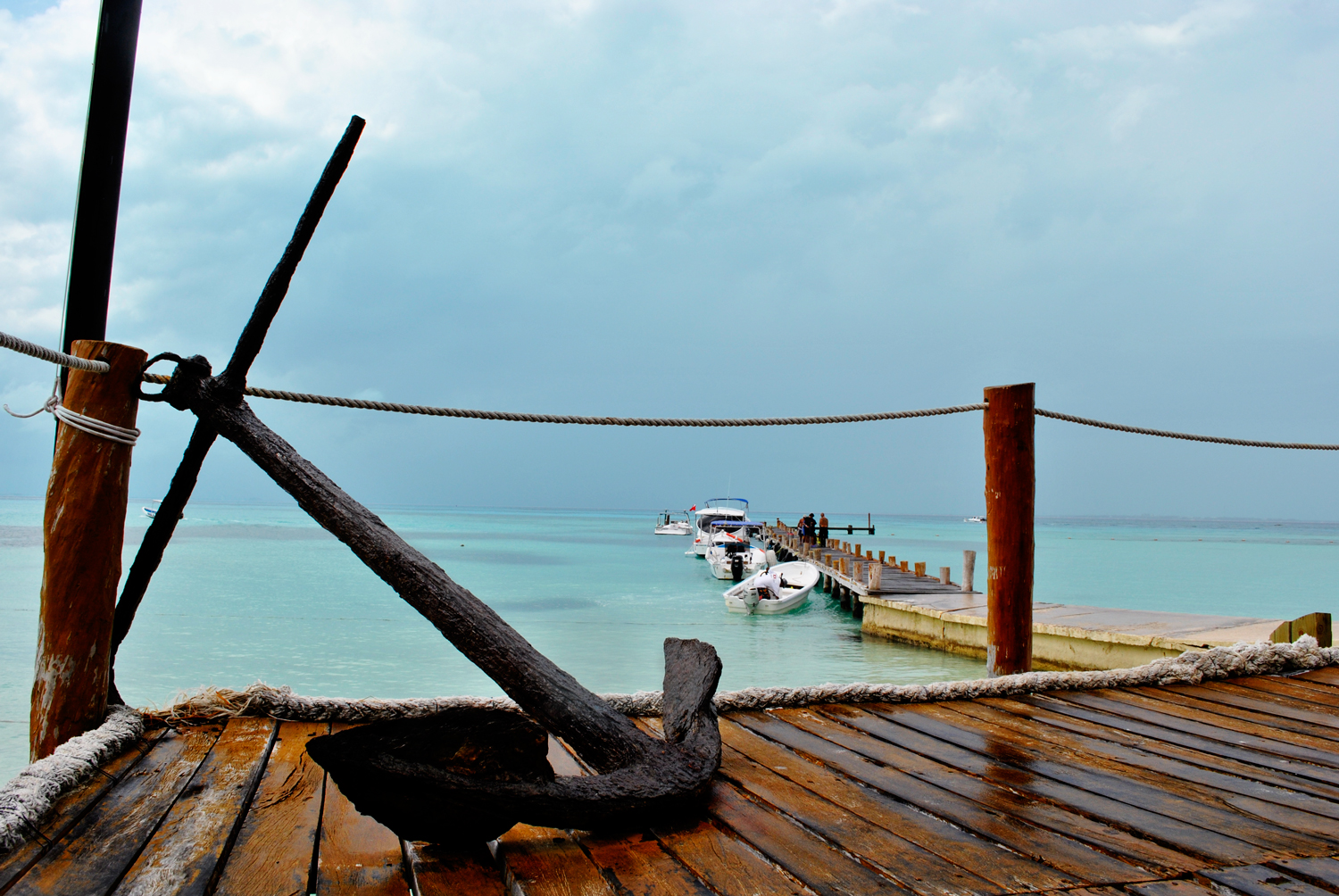 Wooden pier with an old anchor in the foreground and small tour boats moored in turquoise water at Punta Cancún in the Hotel Zone
Hotel pickup changes the math considerably. Many mid-range and premium tours include round-trip transport from hotels in the Hotel Zone and downtown Cancún; some budget listings meet directly at the pier instead. If you are staying downtown or outside the zone, a tour without pickup plus a taxi at six in the morning can quietly erase its headline discount. Conversely, if you are already in the Hotel Zone, meeting at the pier is usually painless and keeps the morning flexible.
Where you sleep shapes your whole boat-tour week, because almost everything starts early. Staying in the Hotel Zone puts you minutes from the piers and the lagoon docks; staying downtown puts you closer to Punta Sam and the whale shark boats. Either way, compare bases before you book:
Check current Cancún rates on Booking.com · Compare Cancún stays on Trip.com
One more logistical note: the Hotel Zone is served by frequent buses running the length of Boulevard Kukulcán, and taxis work everywhere but cost multiples of the bus. R1 and R2 routes connect downtown with the hotel strip and pass within walking distance of most piers (verify locally). If your tour meets at 7:00, leave the resort ninety minutes earlier than feels reasonable — Cancún traffic punishes optimism.
The classic: a catamaran day sail to Isla Mujeres
This is the tour people mean when they say "the Cancún boat trip," and for good reason. A typical shared catamaran day runs seven to eight hours: board late morning, motor or sail across Bahía de Mujeres with music and an open bar already flowing, stop for forty minutes or so of guided snorkeling at a reef or at the underwater museum, then continue to Isla Mujeres where the afternoon belongs to you — lunch at a beach club on or near Playa Norte, time to wander the island's colorful centro, and a golden-hour sail back to Cancún with the Hotel Zone skyline sliding past.
It is a genuinely well-designed day. The sailing segments are short enough to stay fun, the snorkel stop breaks up the boozing, and Isla Mujeres does the heavy lifting with its own charms. For couples and mixed groups, it is the highest-consensus choice: nobody comes back angry.
 Aerial view of Playa Norte on Isla Mujeres, with white sand, palm trees, low-rise hotels and boats anchored in shallow turquoise water
The differences between catamaran products are mostly about crowd size and bar quality. Budget tickets put fifty or more people on one hull with a national-brand open bar; pricier shared tours cap numbers lower, serve imported drinks, and sometimes swap the beach-club buffet for reserved seating at a proper restaurant. There are also adults-leaning party versions that trade the snorkel stop's serenity for a floating dance floor. None of these tiers is wrong — but know which one you bought, because reviews for "the same" tour split sharply along exactly this line.
Practical expectations worth setting:
- The fees arrive at check-in. Marine-park wristbands and dock taxes are commonly paid in cash before boarding, on top of the listed price. Bring pesos or dollars for this.
- Snorkeling is optional and weather-dependent. On windier days crews sometimes shorten or skip the reef stop; the island portion still happens.
- Lunch quality tracks ticket price. Included buffets at partner beach clubs are filling rather than memorable; foodies should eat in town instead.
- Seasickness is manageable but real. The crossing is short, but the swell picks up on the open-water legs. Take your remedy before boarding, not after.
Compare dates and boat sizes before committing — inventory changes constantly:
Compare Isla Mujeres catamaran tours on GetYourGuide · See Viator catamaran options
If you fall in love with the island — a common outcome — you can always return under your own steam later in the week; the public ferry guide to Isla Mujeres covers that crossing, and Playa Norte itself deserves its own unhurried day.
Snorkel-first trips: MUSA, Manchones and Punta Nizuc
Travelers whose priority is actually being in the water should skip the all-day format and book a dedicated snorkel trip instead. These run on smaller boats, get to the reef faster, and spend far more time with masks on.
The signature site is MUSA, the Museo Subacuático de Arte, the underwater museum where several hundred human figures sit on the seabed in shallow water, slowly becoming artificial reef. Snorkelers float above the sculptures — faces tilted upward, fish weaving through them — and it is every bit as strange and photogenic as the photos suggest. MUSA installations sit both off Isla Mujeres in the Manchones reef area and nearer the Punta Nizuc end of the Hotel Zone, and different tours visit different clusters, so check which gallery your trip covers if the location matters to you.
 Submerged human figure sculpture colonized by coral at the Cancún Underwater Museum, seen from the surface in clear blue water
Beyond the museum, standard reef stops include the living coral gardens along the national park, where the shallow depth — much of it ten meters or less — makes this one of the friendliest snorkeling environments on the Quintana Roo coast. Currents are mild on calm days, visibility is usually excellent in the morning, and the fish life includes sergeant majors, parrotfish, blue tangs, and the occasional spotted eagle ray cruising the sand flats. If you are building a broader snorkeling shortlist for the region, our Riviera Maya snorkeling guide compares these sites with Akumal, Puerto Morelos and Cozumel alternatives.
Two formats dominate. Traditional snorkel boats take groups of ten to thirty with a guide towing a buoy, gear included. Glass-bottom boats do the same circuit with viewing panels cut into the hull — a nice compromise for mixed groups where some members would rather stay dry, and genuinely better for very young children or non-swimmers who still want to see the statues. Both formats run mornings and early afternoons; the morning slot earns its premium.
Compare Cancún snorkel and boat tours on GetYourGuide · Browse Viator snorkeling cruises
Rules worth respecting, because enforcement is tightening: wear the park wristband, do not stand on coral, skip non-biodegradable sunscreen in the protected area (reef-safe formulas or none at all), and never chase or grab marine life for photos. Guides enforce these inconsistently on crowded boats; going early with a smaller operator is the reliable way to see the reef behaving naturally.
Drive-your-own speedboats: the Nichupté Lagoon "jungle tour"
The oddest and most Cancún-specific option is the jungle tour: you pilot a small two-person speedboat yourself, following a guide's lead boat through the winding mangrove channels of Nichupté Lagoon, then exit through a canal to the Caribbean side for a snorkel stop near Punta Nizuc — sometimes right over the shallow MUSA installations.
It is equal parts theme-park ride and nature tour. The lagoon section is genuinely pretty: glassy water between walls of red mangrove, herons lifting off, the occasional crocodile sunning itself that everyone photographs and nobody approaches. Then you open the throttle in the wider stretches, get thoroughly sprayed, and understand why they make you leave your phone in a locker. After thirty-five to forty-five minutes of driving you drop anchor at the reef, where the pace drops completely and the same water that felt like a racetrack turns transparent and full of fish.
Who this suits: teenagers, drivers who hate sitting still, families with kids above the operator minimums (typically around six years old, varying by company), and anyone who wants an activity rather than an excursion. Who should skip it: anyone seeking relaxation, non-swimmers uncomfortable with the snorkel segment, and travelers prone to motion sickness — the lagoon chop is short and punchy rather than oceanic, but combined with engine noise and spray it bothers some people. Bring sunglasses with a strap and expect wet shorts regardless of where you sit.
The classic version runs about two to three hours door to door with several departures daily. Long-running operators base themselves on the lagoon side of the Hotel Zone; the format is so popular that multiple companies run near-identical circuits, differentiated mainly by group size and whether they bolt on cultural extras like a Mayan-theme ceremony before boarding.
See GetYourGuide's lagoon speedboat tours · Compare the jungle tour on Viator
Jet ski rentals and wave-runner loops on the lagoon occupy the adjacent niche — same water, no snorkeling, pure throttle time — and most lagoon marinas offer them by the half hour. If your group splits between adrenaline and scenery, pairing a jungle tour for some with a lagoon wildlife cruise for others works well; they frequently depart from neighboring docks.
Whale shark season: the trip worth planning a vacation around
From late spring to early autumn, one of the largest animal aggregations on the planet forms in the plankton-rich blue water off the northeastern tip of the Yucatán Peninsula, and Cancún is the main launch point for seeing it. Whale sharks — bus-sized, entirely harmless filter feeders — gather in numbers that regularly reach double digits per boat trip, cruising just under the surface with their enormous mouths open.
The regulated season runs from mid-May to mid-September, set annually by Mexico's environment ministry, with the most dependable encounters from late June through August and sightings tapering in September as the sharks disperse. Tours are snorkeling only — scuba is prohibited — and strict rules govern the encounter: swimmers enter in pairs with a certified guide, keep a respectful distance, touch nothing, and rotate so every guest gets multiple drops. Boats must hold specific permits for the aggregation zone, which is why legitimate operators ask you to book ahead and why July and August weekends sell out well in advance.
 Whale shark feeding near the surface in blue open water, with snorkelers watching from alongside
Set expectations correctly and the day delivers hard. Departure is early — boats typically leave the Punta Sam area by eight — followed by a run of an hour or more to open water. Sightings are probabilistic wildlife viewing, not an aquarium: most days find sharks quickly, but operators work radio networks and no honest guide promises numbers. The payoff, gliding beside a shark longer than your car at arm's length, routinely ranks as travelers' single best memory of Quintana Roo.
Practical notes that matter:
- Book a permitted operator, not the cheapest listing. Ask directly whether the boat holds current-season authorization; legitimate sellers answer plainly.
- Take seasickness precautions seriously. You will be standing in a rocking boat in open swell for hours. This is the single most common complaint in otherwise glowing reviews.
- No sunscreen in the water. Even reef-safe lotion is typically banned at the aggregation; protection is a rash guard and hat.
- Pack patience for the ride. Long transfers, waiting circles, and rotation queues are part of the format.
Compare whale shark tours on Viator · See GetYourGuide's Cancún wildlife tours
Outside the season, the same waters offer year-round alternatives: turtle snorkeling at Akumal to the south, bull diving further afield, and ray season in between. If marine megafauna is your priority and your dates land between September and May, adjust expectations accordingly rather than trusting any operator promising whale sharks off-season.
Sunset sails, pirate ships and dinner cruises
When the day-trip crowd clears out around five, a second fleet takes over. Evening boat options in Cancún divide into two moods, and choosing wrong between them is the most common mistake in this whole category.
The first mood is romantic and quiet: small sailing yachts taking six to a dozen guests out for two hours of golden light on Bahía de Mujeres, wine, canapés, and the Hotel Zone towers turning orange across the water. Sunset sails run most evenings when the port is open, board from Hotel Zone marinas, and reward travelers who dress slightly better than swimwear. Winter departures happen earlier than summer ones, obviously; confirm the boarding time rather than assuming.
The second mood is theater. Cancún's signature evening cruise is the pirate ship format — full-scale replicas of Spanish galleons crewed by costumed performers who stage sword fights, kidnap volunteers from the audience, fire the cannons at a rival ship, and serve a steak-or-lobster dinner with open bar between acts. It sounds kitschy and is, gloriously, and it is also one of the best-reviewed family activities in the entire hotel zone: children under ten tend to lose their minds with delight. An adults-leaning late variant leans harder into the drinking and dancing.
Pick honestly between the two. The pirate ship is an evening of manufactured fun — loud, interactive, excellent with kids — while the sunset sail is an actual experience of the bay's famous light. Mixing them across two nights solves the argument entirely.
Evening cruises carry the same dock-tax reality as day tours: a per-person port fee is typically collected at boarding in cash, and the open bars pour national brands unless you upgrade. Weather cancellations follow the harbor master exactly like daytime operations, so if your anniversary sail falls during a February norte, have a restaurant backup.
Browse Cancún sunset and dinner cruises on GetYourGuide · See the Captain Hook pirate dinner cruise on Viator
Party boats and booze cruises
There is a large, loud, entirely legitimate market for floating nightlife, and pretending otherwise would make this guide useless for a significant share of readers. Party boats in Cancún run two basic formats: daytime cruises to Isla Mujeres that function as moving beach clubs — DJ, games, open bar, an anchorage off Playa Norte for swimming — and shorter sunset-or-night sessions that circle the bay with the sound system doing most of the work.
They deliver exactly what they advertise. Reviews split along expectation lines rather than execution lines: travelers who booked knowing it was a floating festival rate them highly, while travelers hoping for scenic tranquility aboard a boat labeled "party cruise" write the angry paragraphs. Read the listing title literally and you will not be disappointed.
These tours skew young-adult and group-shaped — bachelor and bachelorette parties are core business — and most explicitly market themselves as such. Safety basics apply more than usual: open bar means someone at your table should pace themselves, and the swim stop deserves the same caution it would get on shore.
Compare Cancún party cruises on Viator · See GetYourGuide's Cancún cruise options
If your group contains both party animals and peace seekers, remember that Isla Mujeres receives everyone: the party boat docks at the same island where the quiet catamarans unload, and downtown's waterfront bars let the night people rejoin the day people by dusk.
Private charters and yacht rentals
Once your headcount crosses about six, private charters stop being a luxury indulgence and start being arithmetic. A private catamaran or sport yacht for up to fifteen guests, priced as a group and split, frequently lands near the per-person cost of two premium shared tours — with total control over the schedule, the playlist, the swimming stops, and the bar.
Charter formats range from barebones four-hour bay cruises to all-inclusive eight-hour Isla Mujeres days with crew, chef, and open bar included. Common occasions: multi-family vacations tired of coordinating five separate bookings, wedding parties, milestone birthdays, and small corporate groups. Most charters customize the route — the standard menu being Isla Mujeres, El Meco reef, MUSA, and the Punta Sur lighthouse approach — subject, always, to whatever the harbor master permits that day.
Three due-diligence notes before wiring money for a private boat. Confirm what "included" covers — fuel surcharges, dock fees, crew gratuities, and food are the usual surprises. Verify the vessel's passenger capacity matches your headcount legally, not aspirationally. And book through established platforms or marina offices rather than social-media intermediaries; the licensing crackdown mentioned earlier applies doubly to privately chartered vessels.
Explore GetYourGuide's Cancún yacht and charter listings · Compare private cruises on Viator
For honeymooners and couples below the economic threshold, the sunset-sail format from the previous section delivers most of the private-charter feeling at a fraction of the price; save the full buyout for groups who will actually fill it.
Fishing charters
Deep-sea fishing off Cancún benefits from the same geography as everything else in this guide: the continental shelf and the Gulf Stream edge sit close offshore, putting billfish water within a short run of the marina. The celebrated window is spring, when white marlin and sailfish passes overlap, though barracuda, mahi-mahi, tuna and wahoo give the rest of the year respectable action. Bottom fishing and light-tackle trips in the bay keep beginners and children engaged when the blue water misbehaves.
Charters run shared and private, half-day and full-day, out of the same Hotel Zone marinas as the tour fleet. Licenses are typically covered by the operator; catch-and-release norms vary, so state your preference when booking rather than at the dock. As with everything else here, legitimacy checks matter — established marina-based outfits with named captains are the safe lane.
Compare Cancún fishing charters on Viator · See GetYourGuide's Cancún fishing listings
Non-anglers in the group generally prefer knowing about this option exists rather than joining it; pair a fishing morning with a beach afternoon and everyone wins.
Tour versus public ferry: when to skip the catamaran
Honesty requires acknowledging the budget path. Public roll-on ferries cross from Puerto Juárez (Gran Puerto) and Punta Sam to Isla Mujeres roughly every half hour during daylight, costing a small fraction of any tour, and once you walk off the dock you can rent a golf cart, eat where locals eat, and lie on the same Playa Norte sand the tours sell as an included highlight. For confident independent travelers, especially backpackers and repeat visitors, the DIY day beats most shared tours on both freedom and price.
The tour still wins in specific cases. First trips to Mexico, where the frictionless package — pickup, snorkel gear, guided reef stop, guaranteed beach-club base — removes every decision. Time-pressed itineraries, where one ticket compresses sailing, snorkeling and island time into a single efficiently scheduled day. And travelers who simply want the open bar to start at ten a.m., which the government ferry notably does not provide.
A middle path many travelers miss: take the tour early in the trip, and if the island hooks you, return by ferry later in the week to explore at your own pace. Our ferry guide covers terminals, operators and timing, and things to do on Isla Mujeres fills the day once you are there.
Seasons, weather and the port-closure reality
Every boat tour in Cancún ultimately answers to two calendars.
The pleasant-water calendar: December through April brings the driest weather, the flattest morning seas and the winter whale-watching bonus offshore, but also the nortes — cold fronts that can shut small-vessel navigation for a day or two at a stretch. May through November trades some wind reliability for warmer water, fewer crowds and the whale-shark summer; this is also Atlantic hurricane season, when tropical systems occasionally reset everyone's itinerary for days. Neither window dominates the other; the honest summary is that Cancún offers boatable weather most days of the year, with occasional enforced pauses that sensible travelers absorb with a buffer day.
Sargassum deserves one calibrated sentence: the seaweed arrivals that affect Caribbean-facing beaches in late spring and summer barely touch the boat-tour experience itself — you are usually motoring past the floating rafts rather than through them — but they can change the color of your beach-club afternoon on Isla Mujeres' calmer western shore less than Cancún's open east-facing beaches. Our Cancún sargassum guide tracks the seasonal pattern.
The port-authority calendar overrides everything. When the Capitanía de Puerto hoists restrictions, tours cancel regardless of prepaid status, and reputable operators reschedule or refund automatically. Two habits protect you: booking with cancellation flexibility during December–February and September–November, and checking with your operator the evening before rather than discovering a closure at the dock. Local news outlets and the port captain's notices relay closures; your operator's WhatsApp message remains the fastest channel (verify locally).
Morning slots earn their universal recommendation twice over: winds build through the afternoon on most days, and the light for photos peaks before ten and after four.
Booking smart: fees, scams, sunscreen and other fine print
A few final mechanics that separate smooth boat days from frustrating ones.
Budget for the invisible fees. Marine-park wristbands and dock taxes are the region's most consistent surprise, collected in cash at check-in on most shared tours. Whatever your listing price, carry extra pesos for boarding-day fees (verify locally).
Verify the operator, not just the platform. The licensing sweep against unlicensed "pirate" boats is real and ongoing. Bookings through major platforms inherit some vetting; beach vendors loading passengers from the sand without wristbands or receipts fail every check in this guide. Legitimate boats post crew credentials, give a safety briefing, carry sufficient life jackets, and answer permit questions without hesitation.
Sunscreen policy is stricter than most of Mexico. Inside the national park, non-biodegradable formulas are prohibited, and at the whale-shark aggregation anything goes — a rash guard replaces lotion entirely. Pack the biodegradable kind and apply it early.
Motion sickness strategy: medicate before boarding, choose mid-boat seating on catamarans, keep your eyes on the horizon during the open-water legs, and remember that the front trampolines — the best seats on the boat in flat conditions — are the worst seats in a chop.
Tipping: crews on shared tours work substantially for tips; something in the range customary for guided service in Mexico, given at the end, is the norm. Bring small bills.
What to bring, consolidated: biodegradable sunscreen, a rash guard or cover-up, a hat with retention, polarized sunglasses, a dry bag or zip pouches for phones, cash for fees and tips, and your booking confirmation offline. Towels are provided on most mid-range and above tours but confirm for budget listings.
Cancellation flexibility is worth real money in winter. Free cancellation up to 24 hours is standard across major platforms; paying slightly more for it during norte season is rational insurance.
Frequently asked questions
Do Cancún boat tours run every day? Nearly, weather permitting. The binding constraint is the harbor master, not the calendar: nortes in winter and tropical systems in autumn close the port to small vessels irregularly, cancelling that day's tours with rescheduling or refunds.
Are the boat tours safe for kids? Catamaran days, pirate dinner cruises and glass-bottom snorkel trips are family staples; operators publish minimum ages that typically range from around four on big cats to around six on self-drive speedboats. Life jackets are standard equipment, and calmer lagoon-based options suit the smallest sailors best.
How far in advance should I book? Shared catamarans: a few days ahead is usually fine outside holidays. Whale shark trips in July and August: weeks ahead, because permits cap capacity. Private charters in high season: as early as you know your group size.
What happens if my tour is cancelled for weather? Platform-booked tours refund or reschedule per their terms; direct-booked reputable operators do the same, usually proactively by message. This is routine, not exceptional — build a spare day into week-long trips.
Is the open bar really unlimited? On national-brand tours, yes within reason — crews cut off visibly impaired guests. Premium listings upgrade to imported labels; the cheapest tickets pour aggressively mixed cocktails. The bar is real; its quality scales with the ticket.
Can I visit Isla Mujeres without a tour? Absolutely — the public ferries from Puerto Juárez and Punta Sam run frequently all day and cost a fraction of tour pricing. Choose the tour for structure and included snorkeling; choose the ferry for independence and budget.
Which month is best for a Cancún boat tour? March and April pair reliable dry weather with whale-shark anticipation; July and August deliver the whale sharks themselves at the cost of heat and humidity. Whenever you come, mornings beat afternoons on the water.
The bottom line
Book the shared catamaran to Isla Mujeres if you want the definitive Cancún boat day and refuse to overthink it; book a small-group snorkel trip to MUSA if the water matters more to you than the party; drive the lagoon speedboat if your group skews restless; and if your trip falls between June and August, give one morning to the whale sharks, because nowhere else packs that encounter into a normal vacation this accessibly. Whichever you choose, book through a platform or marina with clear cancellation terms, carry cash for the park and dock fees, and let the harbor master — not your itinerary — have the final word on the day.


